How Memodyne Works
What the product is, how the formula is organised, how a daily capsule fits into a routine, and what it is reasonable to expect.
What the Memodyne Product Materials Show
The manufacturer's own four-step summary of the routine, the capsule count and the marks the product carries, reproduced so you can read it directly rather than through anyone's paraphrase.
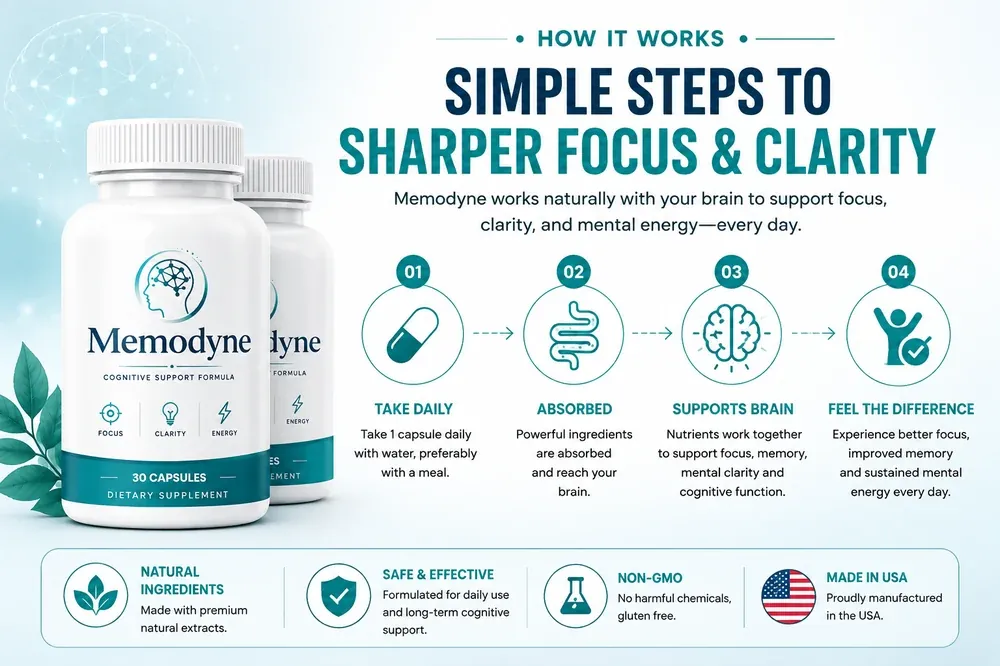
The Memodyne Daily Pathway
Five stages, none carrying a promised timeline.
Your Memodyne daily routine
One capsule daily with water, preferably with a meal, as the product artwork states. Taking fat-soluble components such as DHA and phosphatidylserine with food is sensible and is likely why the instruction specifies a meal. Attaching it to breakfast means nothing depends on remembering.
How Memodyne supports focus and attention
The formula's organising idea is acetylcholine, the neurotransmitter most consistently associated with attention and learning. Alpha-GPC supplies choline as a precursor for it; huperzine A acts on acetylcholinesterase, the enzyme that breaks it down. Two complementary angles on the same system.
How Memodyne relates to mental clarity
Phosphatidylserine is a phospholipid concentrated in brain cell membranes, and DHA is the principal structural omega-3 in brain tissue. Both relate to the membranes in which neural signalling takes place. This is structural nutritional support rather than a mechanism you would feel on a given afternoon.
How Memodyne approaches mental energy
Without stimulants, which is the important part. Vitamin B12 has recognised roles in normal energy-yielding metabolism and in reducing tiredness and fatigue, and ginkgo has been studied around cerebral circulation. Neither produces the acute lift of caffeine, and neither is meant to.
Staying consistent with Memodyne
Bacopa is the clearest illustration of why consistency matters here. Trials of bacopa have generally run for eight to twelve weeks, with effects emerging gradually rather than immediately. A stimulant-free formula is designed to be judged over months, and the 60-day guarantee is a sensible window to use.
How the Memodyne Formula Is Organised
Eight ingredients grouped by what they are actually doing, which is more useful than taking them in order.
The acetylcholine pair. Alpha-GPC at 300mg and huperzine A at 200mcg. One supplies a precursor, the other slows the breakdown of the resulting neurotransmitter. This is the formula's central idea and a coherent piece of design.
The structural components. Phosphatidylserine at 150mg and omega-3 DHA at 200mg, both relating to the composition of brain cell membranes. Worth noting that 200mg of DHA is a modest amount — the commonly cited intake for maintaining normal brain function is 250mg daily, so this contributes toward it rather than covering it.
The botanicals. Bacopa monnieri at 300mg, studied over multi-week periods in the context of memory; lion's mane at 500mg, studied mostly in laboratory and animal research; and ginkgo biloba at 120mg, one of the most studied botanicals in the world with genuinely mixed results.
The nutritional base. Vitamin B12 at 1000mcg, well above the daily requirement, which is common in supplements because absorption of oral B12 is inefficient and because deficiency genuinely does affect cognition.
How to read the research on this Memodyne page
The studies described here examined individual ingredients, usually on their own, at doses set by the researchers, in specific groups of people. That research provides useful scientific context for why an ingredient is included in a formula.
It does not demonstrate that the finished Memodyne product produces the same outcomes. No clinical trial of this finished formula has been published, so nothing on this website should be read as clinical proof of the product itself.
So the fair summary: a coherently designed formula with published amounts, built around a plausible mechanism, containing two components with established nutritional roles and several with research that is real but more preliminary than marketing in this category usually admits. That is a reasonable thing to try. It is not a proven cognitive intervention, and the difference matters.
Memodyne and medication: check before you start
Several ingredients in this formula are pharmacologically active rather than simply nutritional. Huperzine A affects the enzyme that breaks down acetylcholine and should not be combined with cholinergic medication without medical advice. Ginkgo biloba may increase bleeding risk and matters if you take anticoagulants or have surgery planned. Bacopa can interact with thyroid and sedative medication.
Show the label to a pharmacist or doctor before starting if you take any prescription medication, are pregnant or nursing, or manage a medical condition. This is more important here than for a simple vitamin.
Taking Memodyne Day to Day
Small details that decide whether a routine survives its first difficult week.
Take Memodyne with food
The artwork specifies water and preferably a meal, and there is a sensible reason for it. DHA and phosphatidylserine are fat-soluble, and absorption of fat-soluble compounds improves when taken with food containing some fat. Taking it with breakfast covers both the instruction and the habit anchor.
Check Memodyne against your medication first
More important here than for most supplements, because several ingredients are pharmacologically active rather than simply nutritional. Huperzine A acts on an enzyme system also targeted by certain prescription drugs. Ginkgo may affect bleeding risk. Bacopa can interact with thyroid and sedative medication. Show the label to a pharmacist.
Judge Memodyne over months, not days
With no stimulant in the formula there is nothing to feel on day one, and expecting something is the fastest route to abandoning a routine early. The research on the slower ingredients runs over weeks. Give it the length of the guarantee, and set a reminder for around day 50 so the decision stays yours.
What Memodyne Costs to Take Daily
One capsule a day and thirty capsules to a bottle means a bottle covers a month exactly, so the per-day figure is the only number that stays comparable across packages running for different lengths of time.
Six bottles works out at roughly $1.63 a day, three at about $1.97, and a single bottle at $2.30. Whether that represents value is your judgement, but it is worth making against the daily figure rather than the headline discount.

The Memodyne 60-Day Money-Back Guarantee
Every Memodyne order is covered by a money-back guarantee for 60 days. The seller states that the refund applies even to empty bottles and is offered without requiring an explanation, which is a more generous framing than most supplements in this category use.
One practical detail worth planning around. The guarantee runs 60 days while the three and six-bottle packages hold 90 and 180 days of product. Buy six bottles and your decision point arrives at day 60, well before the supply runs out. Set a reminder for around day 50 when the package arrives.
Refund mechanics, including how a request is made and any return arrangements, are handled by the seller rather than by this website. Read the official policy at checkout for the complete terms before ordering.
Make Memodyne Part of Your Daily Routine
One capsule a day, taken with water and preferably with a meal, alongside the sleep, movement and mental engagement that do the heavier lifting for cognitive wellness. Eight named ingredients, stimulant-free, and a 60-day money-back guarantee on every order.
From $49 per bottle · Stimulant-free · 60-day guarantee · Free shipping on 3 and 6 bottles